All Things Succulents, LLC
Variegated String of Pearls Trailing Succulent
Variegated String of Pearls Trailing Succulent
Couldn't load pickup availability
Variegated String of Pearls
Curio rowleyanus ‘Variegatus’
Formerly classified as Senecio rowleyanus ‘Variegatus’
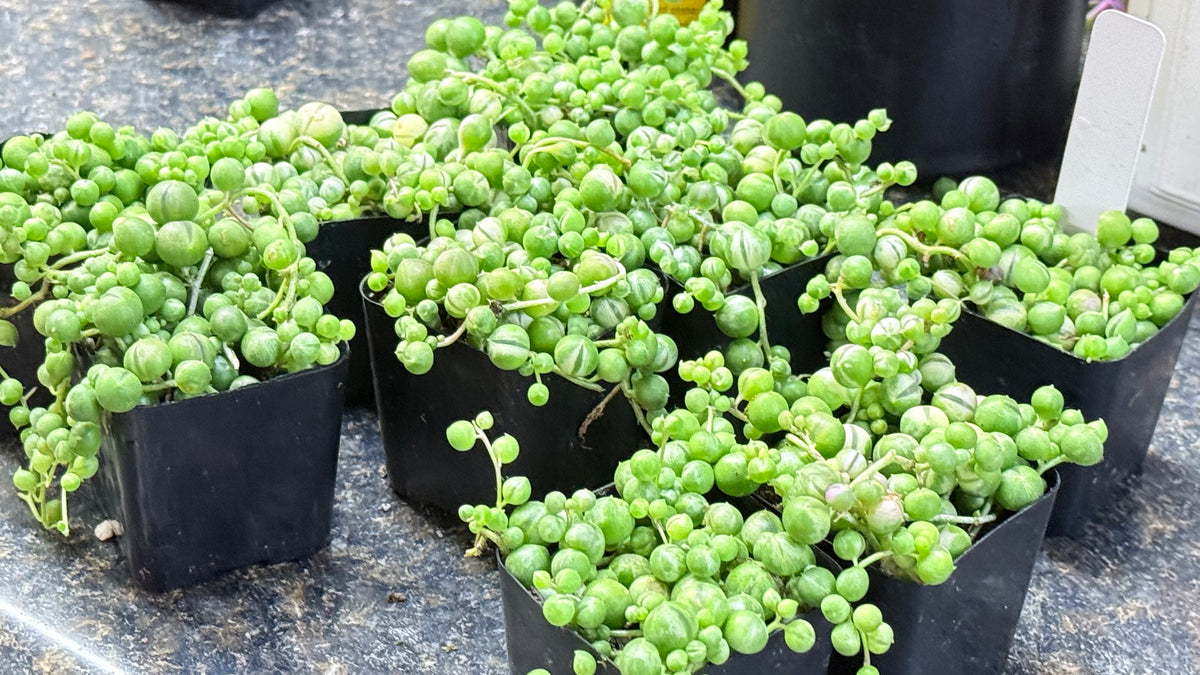
This is a variegated String of Pearls, recognizable by its round, bead-like leaves patterned in green, cream, and white. Some pearls may also develop soft pink or blush tones when grown in very bright light.
Best location in the home: Give this plant a very bright location. An east-, west-, or south-facing window is ideal. A few hours of gentle direct sun can help keep the plant compact and maintain its variegation, although it should be acclimated gradually to intense afternoon sun. A bright sunroom, plant room, kitchen window, or shelf immediately beside a strong window works well. Because the strands trail downward, a hanging planter or high shelf where the top of the pot still receives plenty of light is especially important.
Light needs: Bright indirect light to several hours of gentle direct sunlight. Variegated forms require more light than standard green String of Pearls because the cream portions contain less chlorophyll. In inadequate light, growth becomes sparse, pearls become smaller, and the plant may produce increasingly green growth.
Watering: Allow the potting mix to dry very thoroughly between waterings. The round pearls are water-storage organs, so this plant is much more tolerant of being slightly dry than staying wet. When the pearls begin to look slightly less plump or develop subtle wrinkles, the plant is generally approaching watering time. Use the wooden chopstick test through several areas of the pot before watering.
Important watering caution: Overwatering is the most common cause of failure. Avoid giving small amounts of water frequently. Instead, thoroughly water when the substrate is dry and then allow excess moisture to drain.
Humidity: Normal household humidity is ideal. Approximately 30–50% humidity is usually sufficient. Unlike many tropical houseplants, it does not require high humidity and can actually struggle when constantly damp with limited airflow.
Growth habit: Trailing succulent. New growth initially spreads across the surface of the pot before cascading downward. Stems become increasingly long and branched as the plant matures.
Potential mature size: Individual vines commonly reach approximately 2–3 feet long indoors, although older plants can produce considerably longer strands under excellent conditions.
Growth rate: Moderate during active growth. The variegated form is typically somewhat slower than the standard green String of Pearls.
Plant difficulty: Moderate
It is not necessarily difficult once its watering needs are understood, but it is less forgiving of excessive moisture than many common houseplants.
Pros
- Extremely distinctive foliage
- Beautiful trailing growth
- Excellent hanging-basket plant
- Naturally drought tolerant
- Does not require high humidity
- Easy to propagate from stem cuttings
- Variegation can develop cream, white, green and occasional pink tones
- Mature plants may produce small, fragrant white flowers
I would not recommend this plant for:
Someone who tends to water plants frequently, has only low-light windows, or wants a plant that thrives in consistently moist soil. It is also not the best unrestricted plant for homes where pets or young children routinely chew houseplants.
Toxicity: Toxic if ingested. String of Pearls can cause gastrointestinal irritation in people and pets, and its sap may irritate sensitive skin. Keep it away from cats, dogs, and small children who are likely to chew or handle the plant.
Soil: A very fast-draining succulent or cactus mix is best. Adding additional pumice, perlite, or similar mineral material can help prevent excessive moisture around the roots.
Pot preference: A planter with drainage is strongly recommended. A somewhat shallow container works particularly well because the root system is relatively fine and does not require a deep volume of wet soil.
Best display style: Hanging baskets are ideal, but it also looks beautiful cascading from a tall plant stand, wall shelf, bookcase, or pedestal planter. Whatever display is chosen, make sure light reaches the crown of the plant, not just the hanging strands.
Flowers
Mature plants can produce small white, brush-like flowers, often with a sweet cinnamon-like fragrance. Strong light and proper seasonal conditions increase the likelihood of blooming.
Variegation care
Some stems may occasionally produce mostly green pearls. Green growth contains more chlorophyll and can grow faster than highly variegated sections. If a stem completely reverts to green and begins overtaking the variegated growth, it can be pruned back to preserve the overall appearance of the plant.
Plants with similar needs
It pairs well in a bright succulent area with:
- String of Tears — Curio citriformis
- String of Bananas — Curio radicans
- String of Dolphins — Curio × peregrinus
- String of Watermelons — Curio herreanus
- Burro’s Tail — Sedum morganianum
- Ruby Necklace — Othonna capensis
- Many compact Hoya varieties, although Hoyas generally appreciate slightly more consistent moisture
One particularly useful tip: With String of Pearls, pay attention to the top of the planter. A plant can hang next to a bright window while the crown itself sits above the window and receives very little light. That often leads to thinning or bare growth at the soil line even though the hanging strands look well-lit.
Overall: Variegated String of Pearls is an excellent choice for someone who wants an unusual trailing plant and already understands succulent-style watering. Give it strong light, excellent drainage, and considerably less water than the average tropical houseplant, and it can develop into a spectacular cascading specimen.
Share